
AI Architecture
How to build AI systems that hold their shape: structure, drift, connected data and the methods that keep a fleet honest.
I didn't invent this. Here's who did the hard part.
Two weeks of method, and the honest coda: I didn't invent this. The thinkers who did the hard part, named, credited, and worth reading yourself.

Plant it right, and it holds without you.
The finale: reliability was never about watching harder, but where you keep your guarantees. Plant the structure right and it holds without you.
The model is the tenant. Your data is the building.
When a better model ships next month, is that exciting or terrifying? Your answer reveals whether the model is your tenant, or the whole building.
Nobody reminds gravity to hold the planets.
Nobody reminds gravity to hold the planets, the oldest reliable machine runs with no one watching. What that says about building systems that don't rot.
If it can't be proven wrong, it's not a method, it's a belief.
A belief and a method look identical from the outside. The only way to tell them apart is to try to prove one wrong. So here's how you'd falsify mine.
Four people found the same idea without ever meeting.
Structure over vigilance isn't mine alone, four people reached the same idea from completely different directions, without ever meeting. Why that matters.
I built it to catch me out too. And it did.
The test of any method is the moment it turns on its own author. Mine did, it caught my own confident mistake before it cost anything. Here's how.
I built it in a weekend. It's run itself ever since.
Built in a weekend, self-running ever since. What it looks like when reliability lives in a system's structure, not in someone remembering to watch it.
Seven days, one idea. The whole thing on one page.
Seven days of structure over vigilance, distilled to a single page, the whole argument, nothing padded, nothing left out. Start here if you read one.
Two pillars for the machine. The third stays yours.
Two of the three pillars of a reliable AI system you can hand straight to the machine. The third, the strategy, stays yours, and always will.
You can't tend a field you can't see
You can't tend a field you can't see. Why visible, connected data, not memory or dashboards you never open, is the terrain reliable AI actually needs.
Put the AI inside your data
Stop bolting AI onto the outside of your data. Put it inside, connected, single-source, visible, and the model stops guessing and starts knowing.
The most expensive two words in AI work: "just summarise".
“Just summarise” quietly throws away the detail you'll need later. Why the second law of structure over vigilance is the one everyone breaks by lunch.
A wrong name sat in a file for six months. Nobody did a thing wrong.
A wrong value sits in a file for six months and no alarm sounds, because going stale isn't an event. The drift law, and why memory-held rules fail.
AI doesn't forget. So why do our systems still rot?
AI doesn't get bored or forget, yet the systems we build with it still rot. The reason: we keep putting our guarantees in vigilance, not structure.
Make the AI Document As It Builds
Most AI platform builds need half a rewrite, because nobody wrote down what got decided while it happened. The fix: make the AI document as it builds, spec, playbook, decision record and a knowledge graph, written in the same breath as the work.
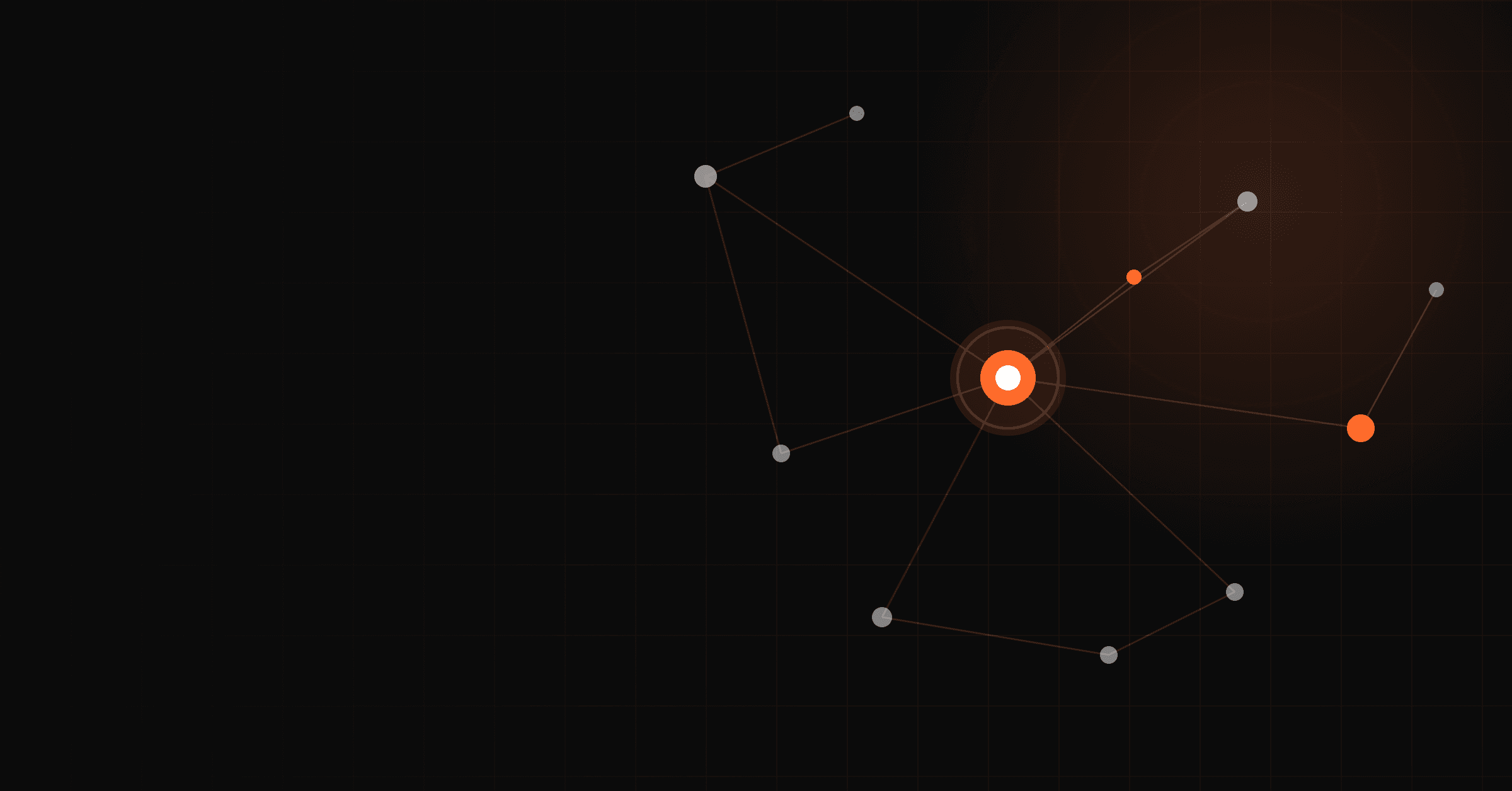
Connected Data, Visualised: See Your Whole Business as One Picture
Most businesses are drowning in data that doesn’t talk to itself. I map it into a knowledge graph you can actually see, your whole business as one connected picture, and the single source of truth every system reads from.
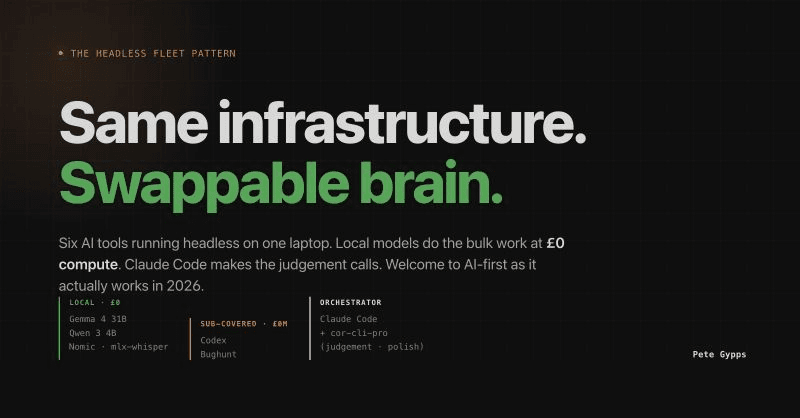
Same Infrastructure, Swappable Brain: The Headless Fleet Pattern
Six AI tools running headless on one laptop, local models doing the bulk work at £0, Claude Code making the judgement calls. Same infrastructure, swappable brain: AI-first as it actually works.
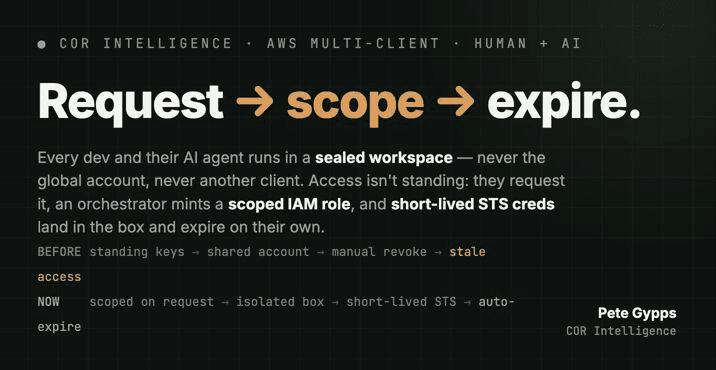
Running Claude Code and Multiple Devs Across AWS, Without Losing Control
How I run Claude Code agents and multiple devs across AWS without losing control, sealed per-dev workspaces, scoped IAM minted on request, and short-lived STS creds that expire on their own.

Parallelism is Essential: 10x Speed Improvements Through Async Execution
Sequential processing is dead. Learn how parallel execution through async generators delivers 10x speed improvements in AI systems, with concrete examples from our Claude Code analysis showing website generation in seconds, not minutes.

AI Learns: Simplicity Wins, Parallelism Essential, UX Drives Architecture
Today marked a breakthrough in our AI architecture: by analysing Claude Code's implementation patterns, our system absorbed powerful design principles that delivered 10x performance improvements. Here's how parallel execution, streaming responses, and the KISS principle transformed our capabilities.

User Experience Drives Architecture: How Streaming Responses Transform AI Systems
Discover why user experience must drive architectural decisions in AI systems. Learn how streaming responses create engaging, responsive interfaces that users love, with real-world examples from our Claude Code analysis.

Simplicity Wins: How KISS Principle and File Search Beat Complex AI Systems
Complex RAG systems with embeddings? Overengineered. Claude Code proves that simple file-based search delivers better results with 10x less complexity. Discover why the KISS principle is revolutionising AI system design.