
Day 10 of 14, Structure Over Vigilance. Pete Gypps, COR Intelligence.
When you've named an idea and built on it, there's a pull to claim more of it than you're owed, to stand up as the lone inventor of something that arrived fully formed in your head. I'm going to do the opposite, and not because I'm being modest. The honest account is the stronger argument. The strength of this idea isn't that I thought of it. It's that loads of people thought of it, separately, without ever talking to each other.
That's the tell. When several people invent the same thing from completely different directions, you're not looking at an opinion any more. You're looking at something closer to a law.
I didn't invent the core, and that's the point
Let me be precise about what's mine and what isn't. I named a framing, I've been calling it structure over vigilance, and I've pushed it hard down one road. But the middle of it, that reliability belongs in the shape of a system rather than in someone's discipline, got arrived at independently by people whose problems have nothing to do with each other.
If I'd made it up on my own, you'd be right to be sceptical. One clever bloke with a neat theory is exactly how bad ideas get dressed up and sold. But that's not what happened. What happened is I spotted, in my own work, a pattern a lot of other people had already spotted in theirs, and the fact we all landed in the same place without coordinating is the thing that should make you take it seriously.
The four witnesses
Count them, because the count is the argument.
From the workflow-automation side: there's a filesystem-first methodology called ICM that gets there cleanly. Its claim, near enough word for word: if the prompts and context for each stage of a process already live as files in a tidy folder hierarchy, you don't need multiple agents or a coordination framework. Read that again. It's the drift law, put the guarantee in the structure and the elaborate machinery becomes pointless, said by someone who'd never heard my name for it. They got there trying to make automated workflows reliable, and the structure fell out on its own.
From the data side: Google shipped the Open Knowledge Framework, markdown files carrying structured metadata, sat over data as a meaning layer. Different problem entirely: how do you make a big pile of data legible and connected? Same answer: structure the data itself, in plain files, so the structure carries the meaning. Same place, opposite end of the building.
From the tooling side: the teams building the sharpest agentic coding tools split their systems along exactly this seam, structure that reliably holds versus vigilance that's only asked to. They weren't writing a philosophy. They were trying to build agents that don't fall over, and the line they drew to do it is the same line.
From the personal-knowledge side: the folder-based "second brain" lot, who've never written a line of production code in their lives, found it too. Keep your knowledge as connected files with explicit links and the structure does the remembering for you. No code, same shape.
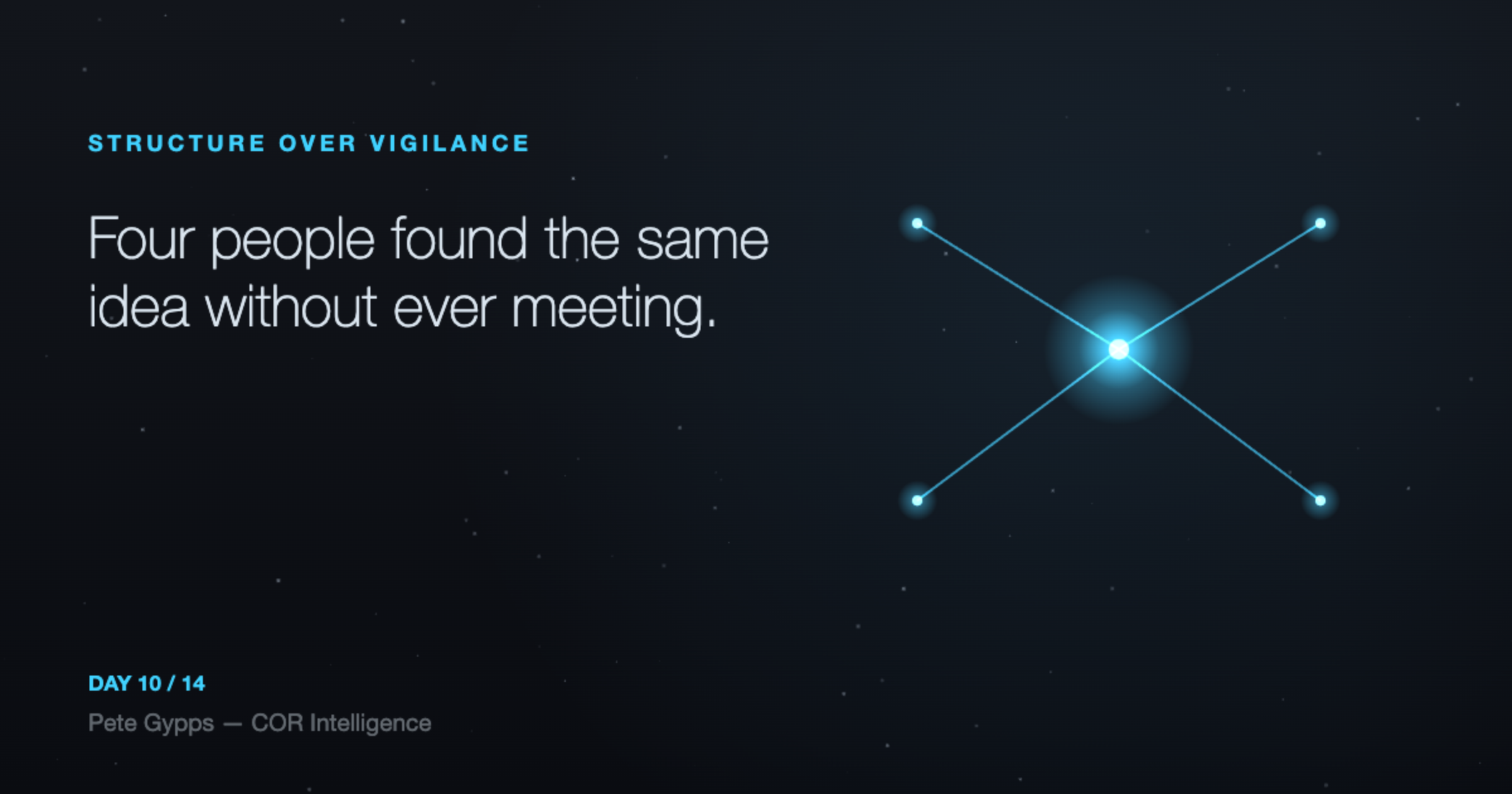
Four fields. Four vocabularies. Four completely different problems. And out of all of them, the same shape falls: put the guarantee in the structure, connect the data properly, don't rely on anyone remembering.
Condorcet's jury, 1785
There's a bit of maths that explains why this convergence is evidence and not just a nice pattern.
In 1785 Condorcet proved what's now called the jury theorem. Take a group of independent judges, each more likely than not to be right, with errors that aren't copied off each other. As the group grows, the odds their majority verdict is correct climb towards certainty. The independence is the crucial bit. Judges who copy each other add nothing, that's one judge in several coats. But judges who reason separately, off separate evidence, and still agree, are telling you something real about the world.
Independent rediscovery is that theorem walking about in the wild. Each of those four came to the structure from their own direction, on their own evidence, with mistakes that have no reason to line up, one's building workflows, one's structuring data, one's hardening agents, one's organising notes. And they converged. By the theorem, that should push your confidence up sharply, in a way no single confident advocate, me included, ever could.
That's why the honest version is the stronger one. Stand me up as the sole inventor and you've got one judge, and one judge can be wrong. Point at the convergence and you've got a jury.
What's actually mine
So if the core isn't mine, what is? Three things, and I'll stand behind all of them.
First, I pulled it from a static workflow to a living estate with a clock on it. Most versions of this treat structure as something you set up once and it's correct. But some faults only show over time, references go stale, copies drift, freshness rots. Structure on its own is a snapshot. Add a clock, scheduled checks that catch what only turns up across days, and it becomes a system that stays true, not just one that started true.
Second, I made the laws testable. "Nothing's lost silently" is a lovely slogan and a worthless one until it's an assertion that actually runs, counts, reconciles, and goes red when it's broken. That's the whole of tomorrow's piece, so I'll leave it there.
Third, I built the instrument, the thing that applies the laws to a real estate and renders the result, so you can watch your structure hold instead of taking it on faith.
Naming it clearly, sharpening it, testing it, building the tool that proves it, that's real work, and I designed every bit of it on purpose. But it sits on top of a core that reality handed to four of us at once.
Why convergence beats authority
The usual way ideas get sold is authority: trust this because a clever or credentialed person says so. Convergence is a different footing entirely, and a much stronger one. It doesn't ask you to trust me, or Google, or any single source. It asks you to notice that people with no connection to each other, solving unrelated problems, keep digging up the same structure, and to draw the obvious conclusion.
An opinion is something you argue with. A pattern that four independent people dig up separately is something you build on. Reality keeps enforcing this one, which is exactly why it keeps getting rediscovered, and I keep finding more of them.
Pete Gypps, COR Intelligence. Next: make your theory able to be wrong, the falsifiability that separates a method you can trust from a manifesto you can only believe.