
Most AI platform builds come out the far end needing half a rewrite. Not because the AI's bad at building, it's usually fine at that. It's because nobody wrote down what got decided while it was happening. So three weeks later you're staring at your own system with no idea why it's shaped the way it is, and neither is the AI, because the conversation where it all got decided rolled off the top of its context days ago. You end up reverse-engineering a thing you built last month. That's not a rare failure. That's the default.
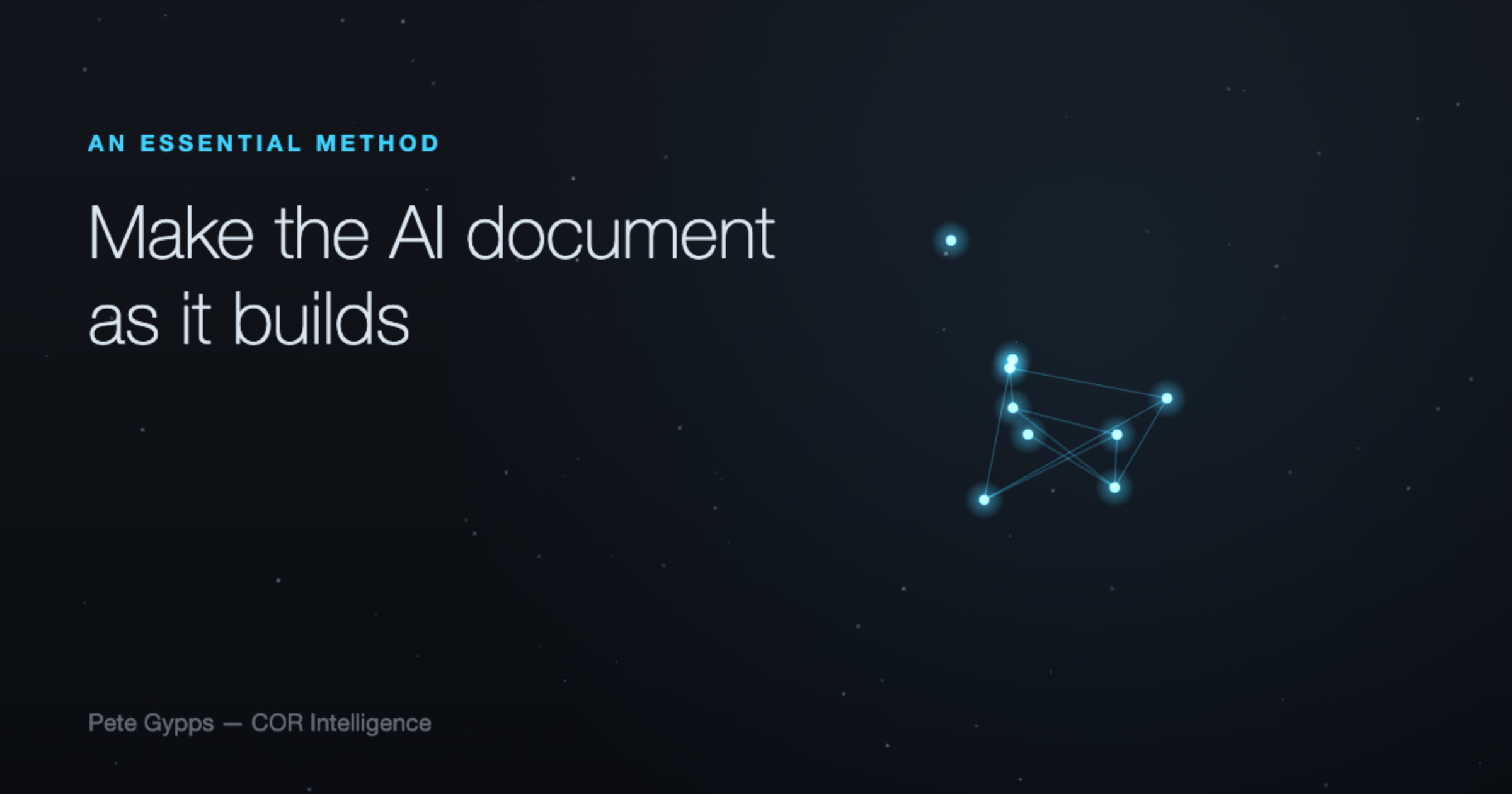
The fix is stupidly simple and almost nobody does it: make the AI document as it builds. Not a docs pass at the end. In the same breath as the work.
Four things, generated while the thing is being built
A specification file. What you're building and what it has to do, kept current as it changes. Not a doc written once at kickoff and never opened again, the live statement of intent that every decision checks back against. When someone asks "should it do X?", the spec answers, or the spec gets updated on purpose. Either way it stays true.
A playbook. How you run it, deploy it, and fix it when it falls over at 2am. Written by the thing that just built it, while it still remembers which command does what and which config bites. Try writing that six months later from memory and you'll get it 80% right, which is the dangerous kind of wrong, because the missing 20% is exactly the bit you needed at 2am.
A decision record. Every real decision and change, logged the moment it's made: what you chose, why, and what you rejected. This is the one everyone skips and the one that saves you. Most arguments on a build aren't "what should we do", they're "why did we do it this way", and six weeks on, nobody remembers, so someone "fixes" a thing that was deliberate and breaks three others. The record turns that shrug into an answer. It's also where the rejected options live, which matters more than people think: half the value is knowing what you already tried and why it didn't work, so you don't loop back to it in three months and waste a week rediscovering it.
A knowledge graph. The spec, the playbook and the decisions are files, flat, separate, read one at a time. The knowledge graph is the shape: every part wired to every other part, so you can see how it all hangs together instead of opening twenty files and assembling the picture in your head. It's the difference between a filing cabinet and a map. And it's the thing an AI can actually navigate, point it at the graph and it moves through the system the way you'd walk a building, instead of being handed a stack of documents and told to work out which twelve matter.
Why "as it builds", not "after"
Because the why is only fresh in the moment. A docs pass at the end is archaeology. The AI's reconstructing decisions it made days ago from whatever's left in context, and it will get some of them wrong, confidently, in the same fluent voice it uses for the ones it gets right, so you can't tell which is which. Documented live, the record is a byproduct of the work as it happens, captured at the one moment it's cheap and correct. That moment doesn't come back.
Do this and you get a better system first time. Less rework, fewer faults, and, the big one, it's actually rebuildable. The know-how is written down instead of trapped in a chat log that's already gone. Lose the machine, lose the person who ran the build, doesn't matter: the thing can be stood back up from its own paperwork. A system you can't rebuild from its own docs isn't documented, it's just currently working, and hoping.
This is the paper-is-the-product discipline my AI First Principles framework is built on: the guarantees live in the structure, not in a model's memory.
Keep it clean, or the docs become landmines
Now the bit that matters more than all of it, and it's a discipline, not a feature. Keep it clean. Legacy and old things get archived or deleted, never left lying in the live system. Including the paperwork.
Here's why this one's non-negotiable, and why it's the part people get wrong. A stale doc doesn't just sit there harmlessly. It actively lies. A spec describing a feature you cut sends the next person off building the wrong thing. A playbook for how it used to deploy gets someone to run the old command against the new system. A decision record full of choices you've since reversed is a trap laid for whoever reads it next and takes it as current. The moment a doc stops being true, it stops being documentation and becomes a landmine, and the worst part is it looks identical to the real thing, so nobody knows to step around it.
And it compounds. One stale doc, people work around. Three, and they quietly stop trusting the docs at all, at which point you've paid the full cost of writing them and get none of the benefit, because everyone's back to asking around and guessing. Docs are only worth keeping if you can trust them without double-checking, and you can only trust them if the dead ones don't get to stay.
So when something's dead, it comes out. Archived if you might want it later, binned if you won't. Same goes for old code, dead configs, retired versions, anything. Keep an archive, absolutely: a clean, dated place for the things you've retired but might reference one day. But the live system only ever holds what's currently true. That's the whole trick. A system stays trustworthy not because someone occasionally has a tidy-up, but because dead things never get to stay in it in the first place, the cleanliness is in the habit, not the cleanup.
Most people let the cruft pile up and call the mess "history". It isn't history, it's rot. Real history lives in the archive, tidy and out of the way. The live thing stays lean.
So: build it, document it in the same breath, and throw out anything that's stopped being true. Get that habit in and the next build comes out better than the last, one clean system at a time.