
Day 13 of 14, why your data outlives every model. Pete Gypps, COR Intelligence.
Here's a test you can run on any AI system, including your own, without reading a line of its code. When a better model ships next month, will that be exciting, or terrifying?
A better one is coming. Next month, or the month after. That cadence has been relentless for years and it isn't slowing down. So this isn't a hypothetical, it's a scheduled event you already know is on the way. Your honest gut reaction to it tells you, more accurately than any diagram, what you actually built on.
Sand and rock
There are two answers, and they're a long way apart.
If the thought of a new release fills you with dread, it's because you know the bill. The prompts you tuned for weeks, tuned against this model's exact temperament, stop behaving. The scaffolding you wired to its output format needs re-wiring. The little workarounds for its little quirks are now workarounds for quirks that don't exist any more, and nobody's mapped the new ones yet. A better model, and your first move is to book a fortnight to survive it. That's the tell. You built on sand. Your value was living inside one model's quirks, and quirks are the least durable thing in this whole field.
If instead the thought is quietly exciting, a better model, so my system just gets better, for free, while I sleep, it's because your value was never in the model. The model was a component you could swap. It moved through your structure; it wasn't your structure. A stronger one turns up, moves through the same structure, does the same job better, and nothing gets rebuilt, because nothing was built on the model in the first place. That's rock.
Same industry, same release, two completely different mornings. The whole difference comes down to what layer you chose to build on.
You don't own the model
Here's the part that stings if you've staked a product on it: you don't own the model. You never did.
A vendor owns it. They trained it, they host it, they price it, and they'll change it, deprecate it and retire it on their schedule, a schedule set by their research roadmap and their economics, not your product plans. That's not a dig at any vendor. It's just what renting capability from someone else means. And it means anything you build straight on top of the model inherits that lack of ownership as a permanent weak spot. You're putting your house on land you're leasing by the month, from a landlord who's free to redevelop it whenever it suits them.
The prompt you perfected depreciates the instant the model changes. The fine-tuning is bound to a base that'll be superseded. The clever chain of calls that squeezes exactly the right behaviour out of exactly this version is, commercially, a liability dressed up as an edge. Looks like a moat. Turns into a migration.
What you own sits on the other side of that line. Your data, the entities in your business, the relationships between them, the built-up structure of how your world actually fits together, that's yours. Nobody deprecates it. No vendor cycle touches it. It doesn't get a version bump that breaks it. If it's structured, connected and visible, every entity a node, every relationship a stated link, the whole thing navigable instead of scattered, then it's the one durable asset in a stack full of rented, churning parts.
So build there. Build the value at the layer you own, and treat the intelligence as the swappable part it genuinely is.
The tenant and the building
The cleanest way I've found to hold this in my head is a piece of property.
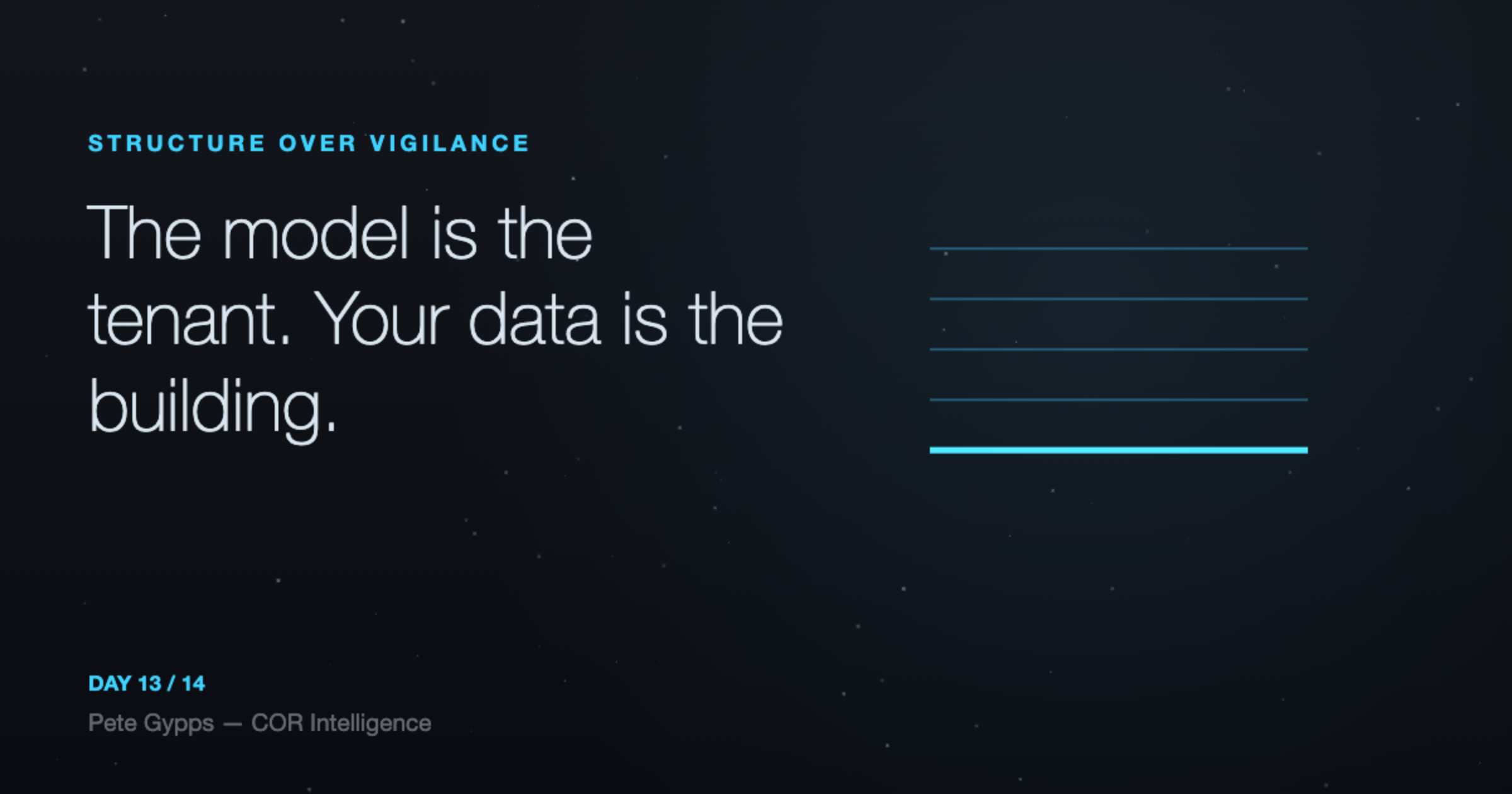
The model is the tenant. Your data is the building.
Tenants come and go, that's what tenants do. This year's model signs the lease, does good work, and in time a better one turns up and takes it over. A well-built building doesn't care. It was made so any capable tenant can move straight in and start working: the rooms are the right shape, the services are where they should be, the plumbing connects. Changing tenants is a Tuesday, not a crisis. You get the upgrade, a stronger occupant, without touching the walls.
Build it the other way round and you get where most AI products are living right now. You pour the foundations to fit one specific tenant, their exact height, their exact habits, their exact quirks. It fits beautifully. It's a showpiece. Then the tenant leaves, because tenants do, and you find you have to renovate the whole building to fit the next one. Every model release becomes a demolition. The thing that looked like bespoke craftsmanship was really a bet that one tenant would stay forever, and none of them do.
Impressive and brittle is a bad place to be standing when the market moves under you every few months.
Build where you own the value
Put the two together, the ownership point and the property, and the strategy writes itself.
The teams that win the next few years won't have the cleverest prompts. Prompts are written on the tenant; they leave when the tenant leaves. The winners will be the ones whose structure is so solid, so genuinely connected, that a new model is a free upgrade rather than an emergency migration. Their moat isn't a clever way of talking to this year's model. It's a building every future model wants to move into, and can, immediately, no renovation required.
This is where the whole argument stops being about reliability and starts being about money. Guarantees that live in structure don't just fail less, they last longer, across the one kind of change this industry actually promises you: the model underneath you getting replaced. The structure is the part that compounds. The intelligence is the part you rent.
So that's the target worth aiming at, and it's the one I keep aiming at, building so the next frontier release lands in my lap as a gift, not an emergency, because I was careful to own the right layer. Excited, not terrified. Not optimism. Just what it feels like to have built on rock.
Pete Gypps, COR Intelligence.