
Day 12 of 14, Structure Over Vigilance. Pete Gypps, COR Intelligence.
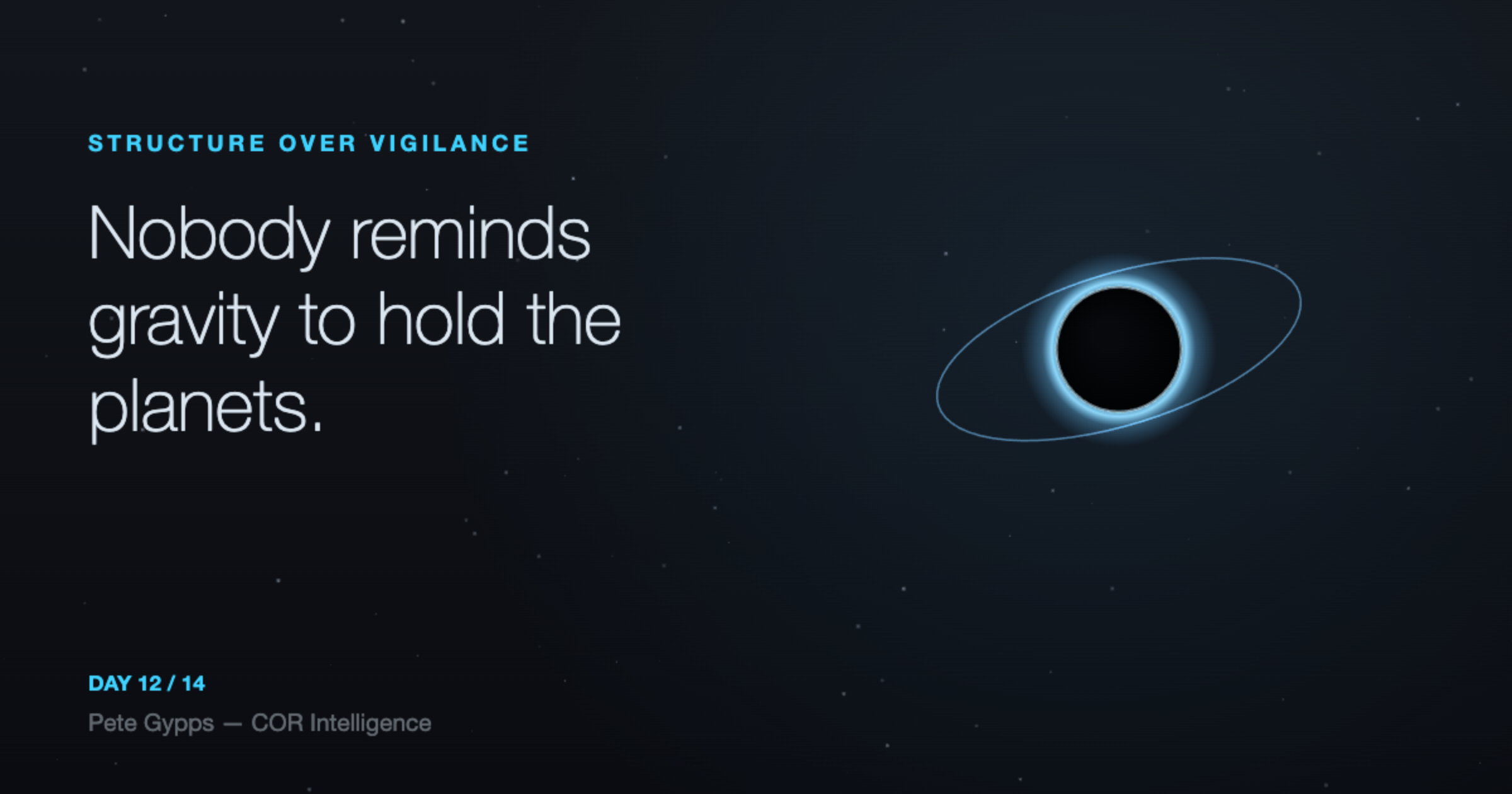
There's no one whose job it is to remind gravity to hold the planets in orbit. No supervisor, no rota, no checklist taped to the side of the solar system. The biggest, oldest reliable machine we know of runs with nobody watching it, and it hasn't missed a beat in billions of years.
I keep coming back to that, not because software is physics, it isn't, but because it points a torch at the exact thing this whole series is about. The most trustworthy reliability in existence needs no observer. And almost all the reliability we build for ourselves needs one badly.
The most reliable system we know has no supervisor
Think about what the cosmos actually is, as a system. Countless bodies, enormous forces, mad timescales, and a level of precision that lets us predict an eclipse centuries in advance. No monitoring team. No one on call. No "make sure the orbits are still correct" step in anyone's morning.
It holds because of its shape. Mass curves spacetime; things in motion follow the curve. The behaviour isn't maintained, it's implied, a consequence of the structure rather than a job done on top of it. Nothing has to remember to keep the planets in line, because there's nothing to remember. The arrangement makes the outcome inevitable.
That's the purest version of the thing I've been going on about all series. The guarantee lives in the shape, so completely that "who's watching?" never even comes up.
A thinking tool, not a physics lesson
I want to be dead clear about what I'm doing here, because it'd be easy to overreach and I'd rather not.
This is a metaphor. A thinking tool. It's not a claim that your codebase obeys Newton, that a well-designed folder hierarchy is a law of nature, or that you can reason about software by doing sums about gravity. Software is built, not discovered; it breaks in ways planets don't; and anyone who tells you their architecture is "physics" is selling you something.
So take the frame for what it is: a way to point yourself somewhere better. Its value isn't rigour, it's aim. When you're deciding how to make something reliable, the cosmos hands you a standard to hold your design against, and the standard is a question. It's a good enough question to change what you build.
Does your guarantee need an observer?
Here's the question the frame forces on you: does this guarantee need someone watching for it to be true?
Run your reliability through that honestly and the results sting. "Someone checks the deploy before it goes out." Needs an observer. "We review it in the pull request." Needs an observer. "Make sure you always update the copy when the original changes." Needs an observer, and a memory, and a good day. Every one of those is real only while a person's actively looking. Take the person away and nothing announces that the guarantee's lapsed. It just quietly stops being true, and you find out later, the hard way.
That's vigilance, and vigilance is the exact opposite of gravity. Gravity doesn't care about attention, it holds whether or not anyone's looking, whether or not anyone remembers it exists. Vigilance is the other way round: it holds only when watched, and the watching is boring, expensive and never-ending. You're paying attention as rent on a guarantee, forever, and the day you stop paying, the guarantee's gone.
The structural version aims at the other standard. You don't ask a person to remember the copy, you bin the copy and point at the original, so there's one of the fact and nothing to keep in sync. You don't ask a person to keep secrets out of the repository, you put the secrets outside the boundary the repository can even see, so committing them isn't a discipline, it's a physical impossibility. Either way the outcome stops depending on anyone looking. It holds because of the shape. That's borrowing the cosmos's trick at human scale.
Why this bites hardest with AI
If observer-based reliability were only expensive, you could argue about whether it's worth the cost. AI takes the argument away, because it takes away the possibility.
You can't watch a system that runs faster than you can read. When an agent's doing in seconds what'd take you an afternoon, "watch it carefully" isn't a safeguard, it's a comfort blanket. By the time you've understood step three, it's on step ninety. A human supervising an agent at full speed isn't supervising anything; they're squinting at the wake of a boat that's already gone.
So with AI, the observer model doesn't degrade gently into "a bit risky." It collapses. The only reliability that survives contact with something faster than you is the reliability that never needed you watching in the first place, the guarantee built into the shape, that holds at three in the morning with everyone asleep exactly as well as it holds under review.
That's why the frame's worth keeping, metaphor and all. It sets the target. Not "how do we watch this more carefully?", that road ends at a system you can't keep up with, but "how do we build this so it holds with nobody watching?" The universe answered that one a long time ago, and the answer was never a bigger monitoring team. It was a better shape.
I'm not there on everything yet. But that's the standard I'm aiming at now, shapes that hold at three in the morning with everyone asleep. Getting closer, one guarantee at a time.
Pete Gypps, COR Intelligence. Next: why your data outlives every AI vendor cycle, and why the next model release should excite you, not scare you.