
Day 4 of 14, Structure Over Vigilance. Pete Gypps, COR Intelligence.
The first three days of this series were all defensive. Guarantees baked into the shape of your data, not held in anyone's memory. One copy of each fact. Nothing lost quietly. All of it about stopping systems from rotting. Today it stops being defensive and turns into the actual point, because the same discipline that keeps your data from rotting is what turns it into something an AI can properly live inside.
How AI works today: fetch, answer, forget
Look closely at nearly every AI tool in front of you and it's the same shape every time.
There's a chat window. You ask something. The model reaches out, grabs a document, a file, a page, a record, drags it into the conversation, answers off the back of it, then forgets it. Ask the next thing and it does the whole dance again from cold. Reach, grab, pull in, answer, forget.
Your data just sits there through all of this. Passive. Waiting to be fetched. It's got no shape the model can see, no relationships it can travel along, no existence beyond being something to drag into a window one bit at a time. The AI's the centre of gravity and your data is luggage it keeps sending out for.
It works, in the narrow sense that you get an answer. But it caps what's possible. A thing that fetches one document at a time can only ever reason about one document at a time. It never sees how anything connects, because connection isn't something you can fetch, it has to already be there.
Turn it round: your data as terrain
So turn the whole thing round.
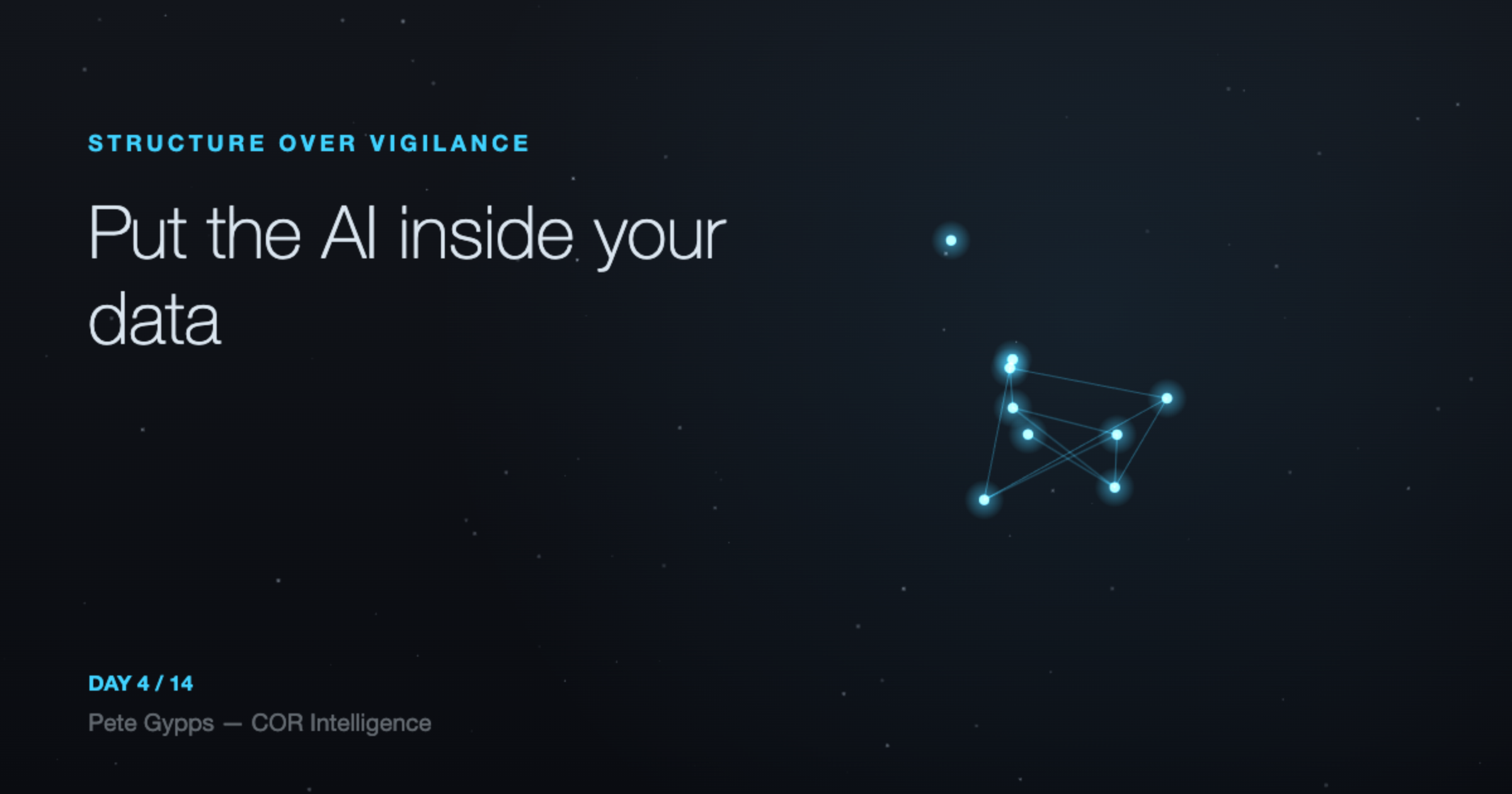
Your data isn't something the AI fetches into itself. It's the ground the AI walks on.
Every thing you own, every client, project, system, document, decision, is a node. Every relationship is a stated link with actual meaning: this client owns that project, that project runs on this system, this decision replaces that one. The links are real, written into the structure, not guessed at on the fly. And the AI doesn't pull your data into a window. It moves through it where it lives, reading the map your structure already is, node to node along the links, the way you'd walk a place you know instead of being handed one photo at a time and asked to picture the whole country from it.
That's not a small difference. Send a tourist on errands and he sees one snapshot at a time and never learns the city, every trip starts back at the hotel. Someone who lives there knows how the streets join up, what sits next to what, which turnings are dead ends. Fetching gives you the tourist, forever. Terrain gives you the local.
The data becomes the agent
Someone building in this space put it better than I could: the data becomes the agent.
Took me a while to properly get that line, so let me unpack it. In the fetch model, all the brains and all the intent sit in the model and the prompt, the data's just dumb stuff to be worked on. In the terrain model, the structure itself carries the meaning. The relationships ARE information. When A points at B and B is marked as replaced, the structure's already telling you something before any model reads a single word of the content.
So you're not instructing an assistant and feeding it scraps anymore. You're dropping it into a landscape it can read for itself. How good the agent is stops being purely about how clever the model is and starts being about how good the terrain is. Give a middling model excellent terrain and it'll run rings round a brilliant model fetching blind, because the brilliant one is rebuilding the map from scratch on every single question, and the middling one is just reading it.
The catch: the data has to be genuinely connected
Here's the catch, and it's the whole reason the first three days had to come first. Terrain only works if your data is genuinely connected.
The relationships have to be explicit. Written down, not living in the head of the one person who knows how it all fits. And they have to point one way, A points at B, B doesn't point back at A. That's not fussiness. It's what stops the whole thing going round in circles, what lets you follow a link and know you'll reach the bottom instead of looping forever.
This isn't a nice-to-have you bolt on once the interesting AI work is done. It's the thing that makes any of the interesting AI work possible in the first place. Connected data is the first pillar of everything I've been writing about, not because it's a tidy habit, but because without it the terrain doesn't exist and the AI's got nowhere to go but back to the chat window.
Why disconnected data can only ever be fetched
Picture the opposite. Facts copied and scattered across a dozen files. Relationships that only exist in someone's memory. A folder of documents with no stated links between them, where the fact that this contract belongs to that client is something you just know rather than something written anywhere a machine could follow.
Data like that can't be terrain, because there's no map in it. Nothing to navigate, no links to travel, no structure to read. All you can do is fetch, pull one document into a window, look, put it back, pull the next. That's exactly why so much AI stays stuck in the chat window and never becomes more: the data underneath was never connected, so fetching's genuinely all it can do. The limit people blame on the AI is usually a limit of the terrain they gave it.
It's the same discipline, seen from the other side
Here's the satisfying bit. The defensive discipline and the offensive capability turn out to be the same discipline, just seen from two sides.
The drift law said: one copy of each fact, pointed-at, never copied. That's exactly what makes something a node, one canonical thing other things can link to. Copy the fact into five files and you haven't got a node, you've got five drifting fragments and no map.
The signal law said: nothing lost quietly, everything kept and reachable. That's exactly what keeps the terrain whole, no dropped links, no orphaned nodes, no gaps you can't see.
Do those two things and you don't just get reliability. You get terrain thrown in, for free, as a side effect. The same structure that stops your system rotting is the structure the AI can live in. You were never choosing between a safe system and a capable one. Build it right for safety and you've built it right for the AI to move through.
So stop pouring money into better ways to fetch, better retrieval, cleverer prompts, bigger windows, all of it just polishing the tourist's errands. Build data worth living in, and keep building it out, one connection at a time.
Pete Gypps, COR Intelligence. Next: you can't tend a field you can't see, why the map has to be visible, and why that's not decoration.