
SEO isn't one thing, it's a hundred connected signals
Most SEO advice hands you a checklist: fix your titles, add some schema, chase a few links. But search doesn't work as a checklist. It works as a system, content, technical health, speed, structure, rankings and off-site signals like backlinks, all pulling on each other at once. Treat them as separate boxes to tick and you'll miss what actually moves the needle: how they connect.
So I don't tick boxes. My systems pull every signal in and map them into one connected picture, the same connected-data and visualisation approach I bring to everything. Backlinks are a perfect example of why that matters.
A backlink is a vote, but not all votes are equal
A backlink is another website linking to yours. In search terms it's a vote of confidence, and for two decades it's been one of the strongest signals there is. But a vote from a national newspaper isn't the same as a vote from a spun-up directory nobody reads. What actually matters about a link is:
- Who's linking, the authority of the site and the exact page pointing at you.
- Whether it passes value, a normal (dofollow) link passes authority; a nofollow, sponsored or UGC link counts as a mention but passes none.
- The anchor text, the words used to link to you, which tell search engines what you're about.
- Whether it's healthy or toxic, some links actively drag you down and need disavowing.
Authority, measured: "rank"
Every domain and page carries an authority score, a rank, on a scale from 0 to 1000. It's built the way Google's original PageRank was: your rank is a function of who links to you and how strong those linkers are, all the way down the chain. It's compressed logarithmically, so the jump from 200 to 400 takes exponentially more than 0 to 200. New sites sit around 25 to 35; large, authoritative ones reach the hundreds; a rank above 500 is rare air.
The practical upshot: one link from a rank-600 government page can be worth more than a hundred from rank-20 directories. Quantity is a vanity metric. Authority is the real one, and to judge it, you have to see the whole profile.
See your backlink profile, don't read it
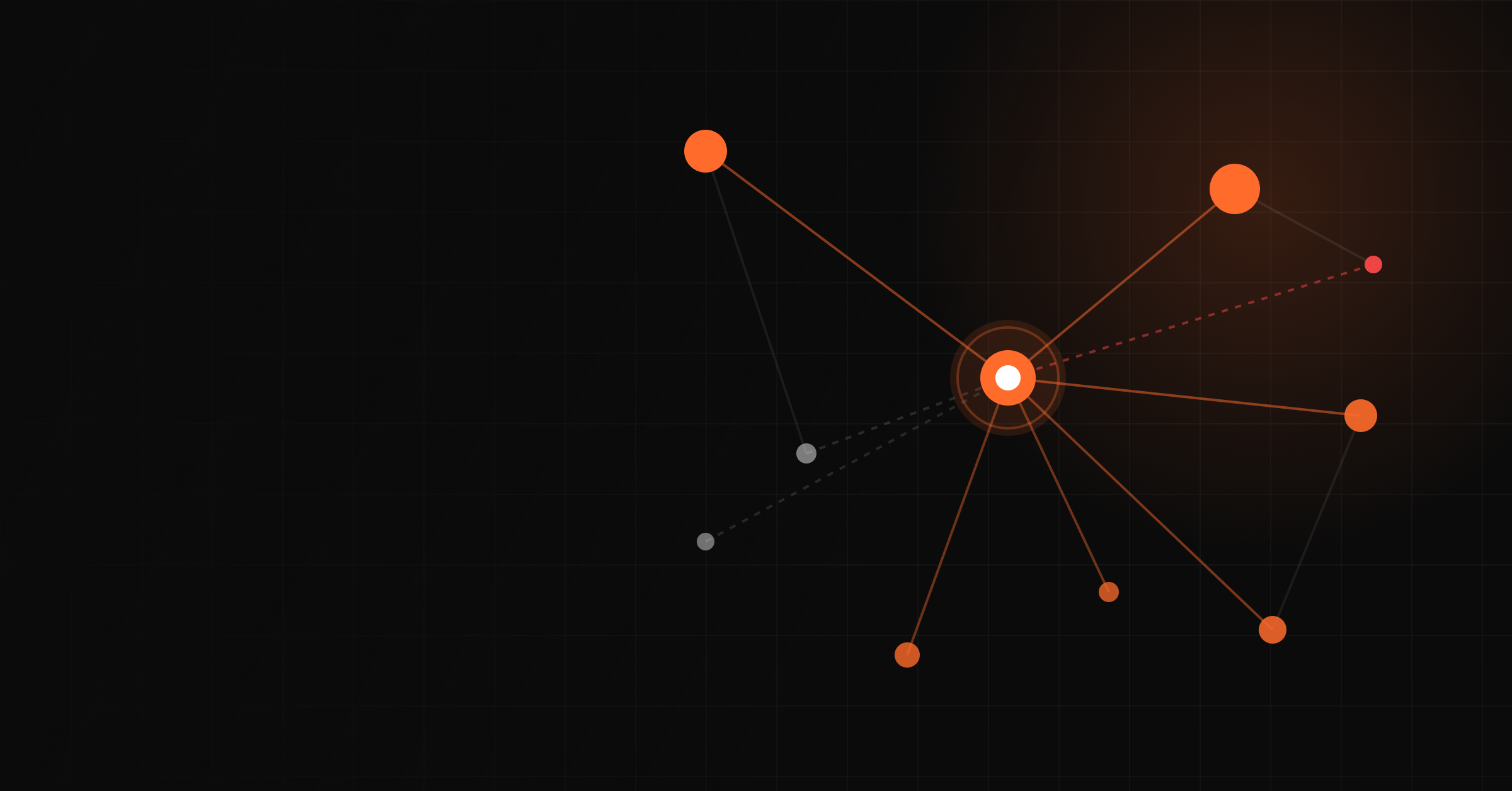
This is where connected data and visualisation earn their place. A backlink export is thousands of rows of links, ranks and anchors, unreadable, and impossible to reason about. So I don't hand you a spreadsheet. I map your backlink profile into a graph you can actually see: your site at the centre, every referring domain around it, sized by its authority and coloured by whether it helps or hurts. The orange links pass authority inward; the dim ones are mentions only; the red one is toxic. Hover any domain to inspect it.
In one picture you can immediately see what a spreadsheet hides: your genuinely strong links, the nofollows that earn reach but not ranking power, and the toxic links to disavow before they cost you. That's the difference between having the data and being able to use it.
Why the graph beats the list
Once it's visual and connected, the insights fall out of it. You can see clusters of related linkers, the gaps where your competitors have authority you don't, over-optimised anchor patterns that look manipulative to Google, and toxic neighbourhoods forming before they become a penalty. None of that is visible in a list. All of it is obvious in a map.
One signal of many, all connected
Backlinks are just one layer. My systems map them alongside your content, your technical health, your rankings and your public footprint, website, video, social, into a single connected picture of your whole search presence. Because SEO isn't a checklist; it's a system, and you can't fix what you can't see.
All of it runs on my AI First Principles (AFP) framework, AI first, human second, and the same connected-data engine behind the map of this very site. If you want to see your SEO instead of guessing at it, let's talk.